



Quick answer: the blinking light on your furnace control board is a diagnostic code. The number of flashes (or the two-digit number on newer furnaces) points to the safety check that failed, most often ignition or flame sensing, the pressure switch and venting, or the high limit and airflow. The code legend is printed on the inside of the blower door, and that label is the most accurate source for your exact model.
Safety first: if you smell gas, do not reset or relight anything. Leave the home and call your gas utility (Nicor Gas 1-888-642-6748, or North Shore Gas 1-866-556-6005) or 911 from outside.
How to Read Your Furnace Code
- Look through the sight glass on the lower door, or take off the upper door if there is no window. Many furnaces stop flashing the code once the blower door switch is opened, so count first.
- Count the flashes before turning the power off. Turning the power off clears the active code on most boards.
- On two-digit codes (Carrier, Bryant and some Trane boards), a long flash is the first digit and short flashes are the second. One long flash and three short flashes is code 13.
- Lennox furnaces with a display show the code as a number like E223 or 223, and an iComfort or S40 thermostat may show the same code.
- Match it to the legend on the door, then use the guides below.
What the Most Common Codes Mean Across Brands
| Problem area | Lennox | Carrier / Bryant | Goodman / Amana | Trane / American Standard |
|---|---|---|---|---|
| Ignition or flame failure | 270 | 14, 34 | 1 flash | 2 flashes |
| Pressure switch or venting | 223, 229 | 31, 32, 23 | 2 or 3 flashes | 3 flashes |
| High limit, rollout or airflow | 250 | 33, 13 | 4 or 6 flashes | 4 flashes |
| Blower motor | 292 | 41, 15 | varies by model | varies by model |
| Blower communication | 201 | — | — | — |
Code numbers change between board generations, even within one brand, so use this table to understand the problem and the door label to confirm it.
What Each Type of Code Usually Means
Ignition and flame codes
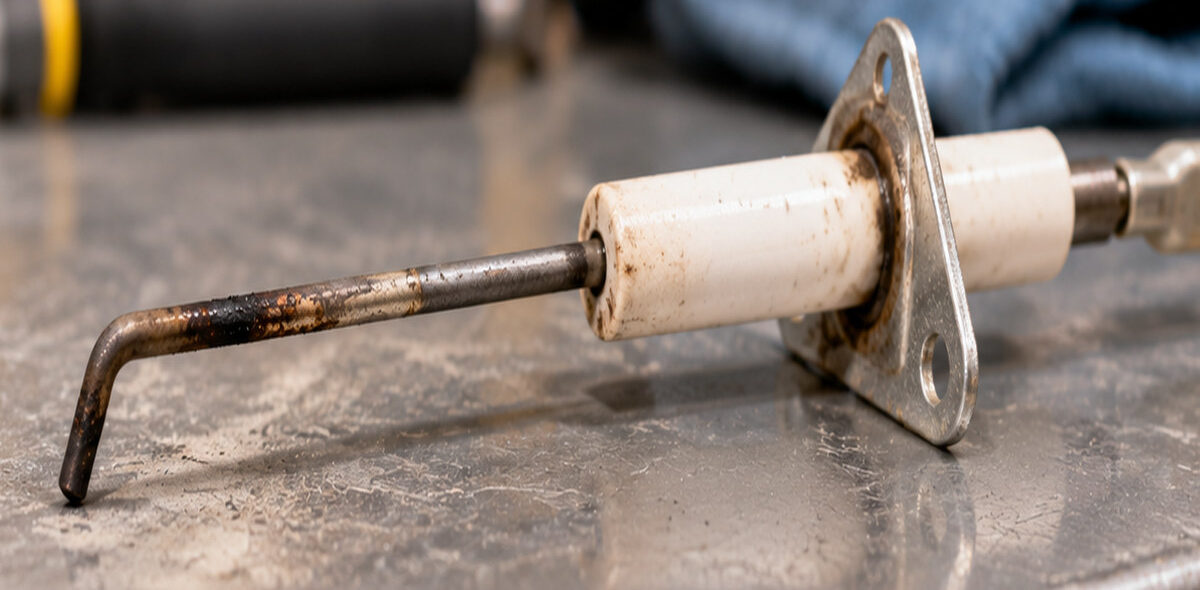
The furnace tried to light and either never saw a flame or lost it. A dirty flame sensor is the most common cause in the homes we visit, followed by a cracked hot surface igniter, a gas supply problem or a failing gas valve. After three or four failed tries, most furnaces lock out for about an hour before trying again.
Pressure switch and venting codes
The inducer fan must prove that exhaust is moving before the gas valve opens. In Illinois winters the usual culprits are snow or ice over the PVC vent pipes on the side of the house, a clogged condensate trap on a high-efficiency furnace, a cracked or water-filled pressure switch hose, or a weak inducer motor. See our pressure switch error guide.
High limit and rollout codes
The furnace got too hot. A clogged filter is the first thing to check, then closed supply vents, a dirty blower wheel or a weak blower motor. A flame rollout switch that trips is more serious, because it can mean blocked venting or a cracked heat exchanger, and it should be inspected before the furnace runs again.
Blower motor codes
The control told the blower to run and it did not, or it ran at the wrong speed. A failed motor module, a seized motor or a jammed blower wheel are the usual findings.
Safe Checks You Can Do Before Calling
- Replace the air filter if it is dirty.
- Check the thermostat is set to heat and its batteries are good.
- Clear snow and ice from the two white PVC pipes outside if you have a high-efficiency furnace.
- Make sure the furnace switch is on and the gas valve handle is parallel with the pipe.
- Reset once. Turn the power off for 30 seconds and back on. If the same code returns, stop resetting and call for service. Repeated resets on a flame or rollout code can be dangerous.
What Furnace Code Repairs Cost
| Common repair behind a furnace code | Our flat-rate price |
|---|---|
| Flame sensor cleaning and flame signal test | $245 |
| Flame sensor replacement | $275 |
| Hot surface igniter replacement | $305 |
| Pressure switch hose replacement | $250 |
| Pressure switch replacement | $355 |
| High-efficiency condensate trap cleaning or replacement | $290 |
| High limit switch replacement | $340 |
| Flame rollout switch replacement | $325 |
| Flue or PVC vent pipe repair | $435 |
| Inducer motor replacement | $570 to $1,410 |
| Control board replacement | $475 to $1,505 |
| Gas valve replacement | $505 to $1,120 |
| Blower motor replacement | $830 (PSC) to $2,220 (variable speed) |
Prices are flat-rate with parts and labor, as of November 2026. The $75 diagnostic is waived when you approve the repair, and Comfort Club members save 10 to 15% on repairs. Exact pricing depends on your furnace model and whether the part is in stock on our trucks.
Seeing a furnace code in the Northwest Suburbs?
Pure Comfort Heating and Cooling services every major furnace brand from our shop in Streamwood, IL. Diagnostics are $75, or $99 on evenings, weekends and holidays, and the fee is waived when you approve the repair. You approve a flat-rate price before any work starts, and phones are answered 24/7.
Brand-Specific Code Guides
- Lennox furnace error codes
- Carrier, Bryant and Payne furnace codes
- Goodman, Amana and Daikin flash codes
- Trane and American Standard blink codes
Frequently Asked Questions
Why is my furnace blinking but not heating?
A blinking light that is not the normal slow heartbeat usually means the control board stopped the furnace after a failed safety check, such as ignition, the pressure switch or the high limit. Count the flashes and match them to the label on the blower door.
What does a steady or slow-blinking green light mean?
On most boards, a slow, steady blink or a solid green light means normal operation with no fault. A rapid flash or a red or amber light usually means a fault or a reversed polarity problem.
Is it safe to keep resetting my furnace?
One reset is fine. If the same code comes back, stop. Repeated resets on a flame, rollout or gas valve code can let unburned gas build up. Call a technician instead.
How much does it cost to diagnose a furnace code?
Our diagnostic is $75, or $99 on evenings, weekends and holidays, and it is waived when you approve the repair. Common code repairs like flame sensor cleaning start at $245 flat-rate.
Do you work on brands other than Lennox?
Yes. We are a Lennox Premier Dealer, but our technicians repair Carrier, Bryant, Trane, American Standard, Goodman, Amana, Rheem, Ruud, York and other brands.
We diagnose and repair furnaces from our shop in Streamwood across Streamwood, Bartlett, Hoffman Estates, Schaumburg, Elgin, Hanover Park, Roselle, Arlington Heights and the rest of the Northwest and West Suburbs. See our furnace repair page for flat-rate prices.